

1. Context
Designing and delivering quality-assured education and training requires strict alignment with the NATO Systems Approach to Training (SAT) phases: Analyze, Design, Develop, Implement, and Evaluate. Because the SAT cycle spans months and involves multiple staff branches, command echelons, course directors, and external stakeholders, institutions often struggle with task handoffs, administrative delays, and role ambiguity.
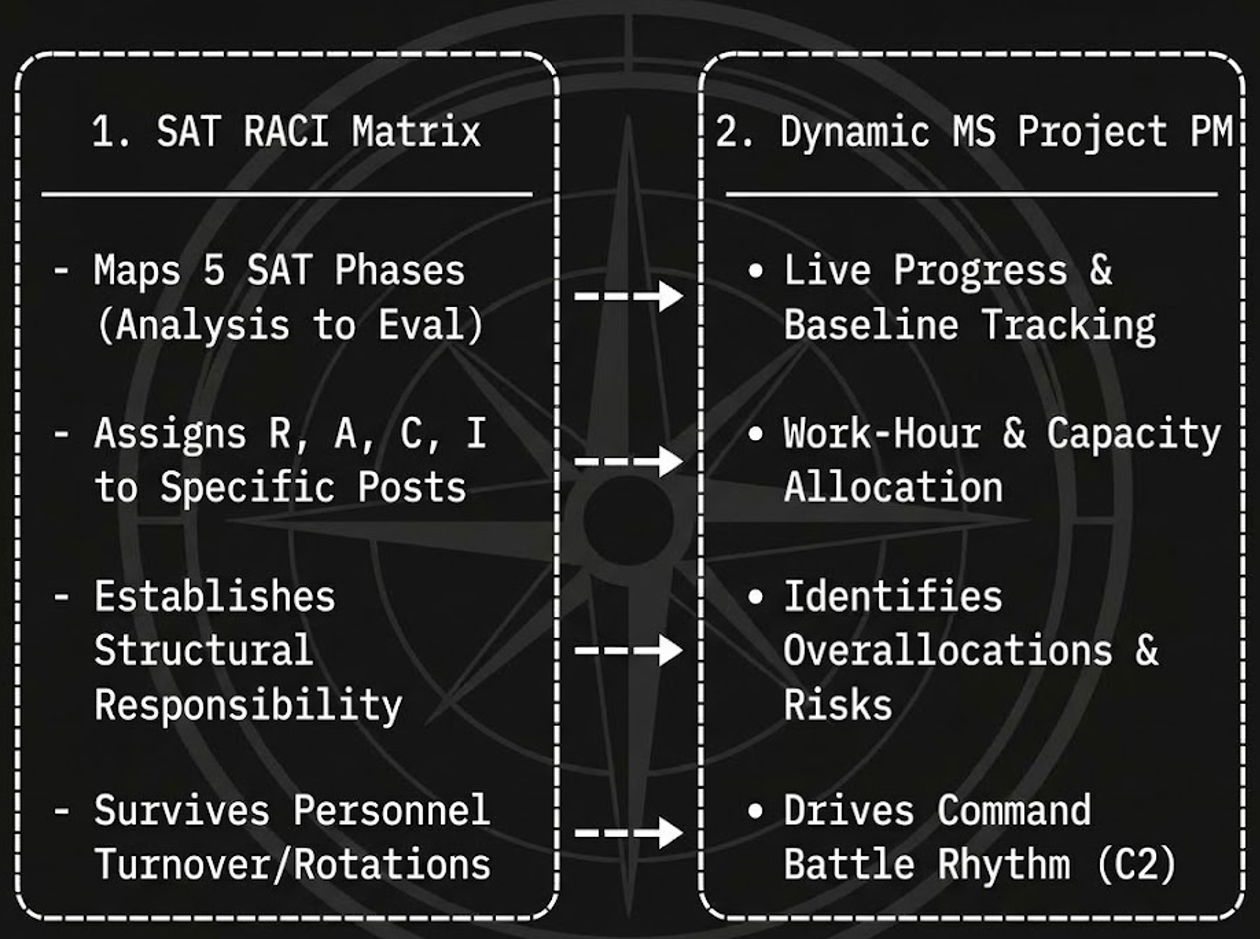
To solve this, the NATO-Georgia Joint Training and Evaluation Center (JTEC) first constructed a comprehensive SAT RACI Matrix and then evolved it into a Dynamic Task-Tracking Database using Microsoft Project. This best practice retains the core clarity of the SAT RACI matrix, assigning every single phase, task, and sub-task to specific post-holders, while leveraging project management software to monitor live execution, work capacity, and deadline synchronization across the entire institution.
2. Core Elements of the Best Practice
a. Comprehensive SAT Phase Breakdown (The Matrix Foundation)
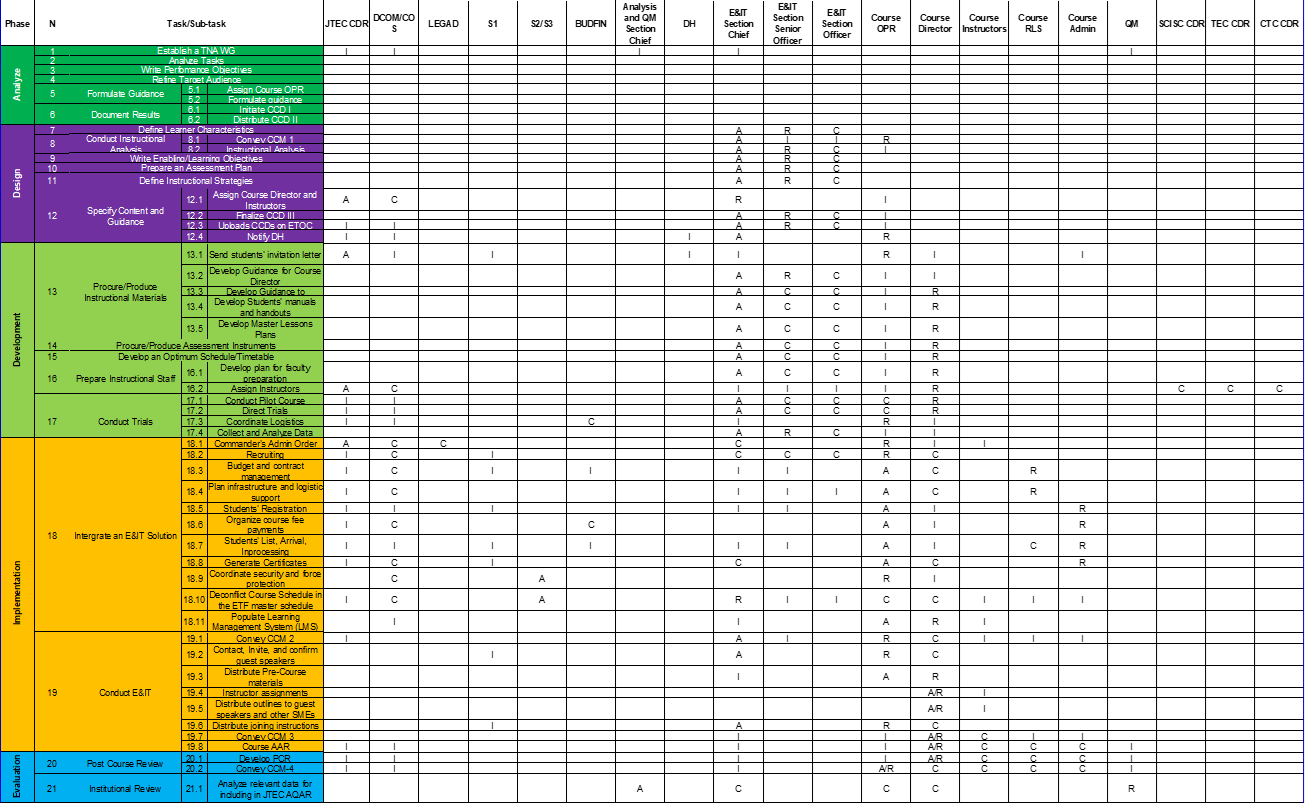
The foundation of this best practice is a complete, standardized RACI responsibility matrix structured around the five phases of SAT:
Analysis Phase: Covers Task Analysis, Performance Objectives, Target Audience Definition, and TNA Working Group establishment.
Design Phase: Guides Course Control Document (CCD) development, Instructional Strategy definition, Learning Objectives, and ETOC alignment.
Development Phase: Governs the procurement and production of instructional materials, lesson plans, student manuals, and assessment instruments.
Implementation Phase: Manages course administration orders, instructor assignments, student registration, facility/logistics support, LMS population, and course execution.
Evaluation Phase: Enforces Post-Course Reviews (PCR), Course Control Meetings (CCM), After Action Reviews (AAR), and input into the Annual Quality Assurance Report (AQAR).
b. Post-Based Ownership vs. Personnel Turnover
Institutional Memory Preservation: Roles are assigned strictly to Posts (e.g., Course Director, E&IT Section Chief, Quality Manager, S-1, S-6) rather than individual names. This ensures that when personnel rotate out, incoming staff immediately understand their exact responsibilities for every step of the SAT process without interrupting course delivery.
Pre-Emptive Task Ownership: Every task is explicitly owned before it falls due. Work transitions smoothly between command staff, developers, and instructors without administrative delays or disputes over responsibility.
c. Evolution into a Dynamic Project Management Database
While the static RACI matrix defines the baseline rules, embedding it into Microsoft Project transforms it into an active management system:
Task Decomposition & Schedule Logic: Each RACI step is broken into specific sub-tasks, duration estimates, start/finish dates, and logical predecessor links.
Live Status Tracking: Moves the organization from passive "Informed" updates to active real-time status synchronization.
Resource & Workload Optimization: Automatically calculates staff work-hours and flags overallocations, prompting command leadership to rebalance workloads during high-tempo periods.
3. Practical Benefits & Impact
Capability | Static SAT RACI Matrix | Dynamic MS Project PM Tool |
SAT Phase Mapping | Maps all 5 phases to institutional posts. | Executes SAT phases as linked project schedules. |
Role Clarity | Unambiguous R, A, C, I designations. | Assigns specific named resource owners to sub-tasks. |
Schedule Control | Establishes general sequence. | Tracks start dates, deadlines, and critical paths. |
Workload Visibility | Identifies who is responsible. | Detects overallocations and work-hour bottlenecks. |
Accreditation Readiness | Demonstrates structured SAT process. | Provides live evidence of quality management execution. |
4. Implementation Guide for the Community of Interests (CoI)
Any Allied or partner Education and Training Facility (ETF) can adopt this two-tier approach through the following steps:
Develop the SAT RACI Matrix: Map all tasks across the five SAT phases against organizational posts (from Command down to instructors and support branches).
Assign Clear RACI Designations: Ensure every task has exactly one Accountable (A) post and clearly defined Responsible (R), Consulted (C), and Informed (I) entities.
Import into Project Management Software: Transfer the matrix tasks into MS Project (or equivalent), establishing task durations, dependencies, and deliverables.
Assign Work Hours & Monitor Overallocations: Input personnel capacity to track workload distribution and resolve resource bottlenecks early.
Integrate into Command Battle Rhythm: Utilize the project database during routine quality tracking meetings to drive continuous improvement and ensure seamless course execution.