

1. Context
In complex defense and educational environments, institutions frequently rely on traditional RACI (Responsible, Accountable, Consulted, Informed) matrices to define roles and responsibilities. While a standard RACI matrix provides a baseline for governance, it often operates as a static reference document—infrequently updated, lacking granular task breakdowns, and disconnected from daily staff workflows.
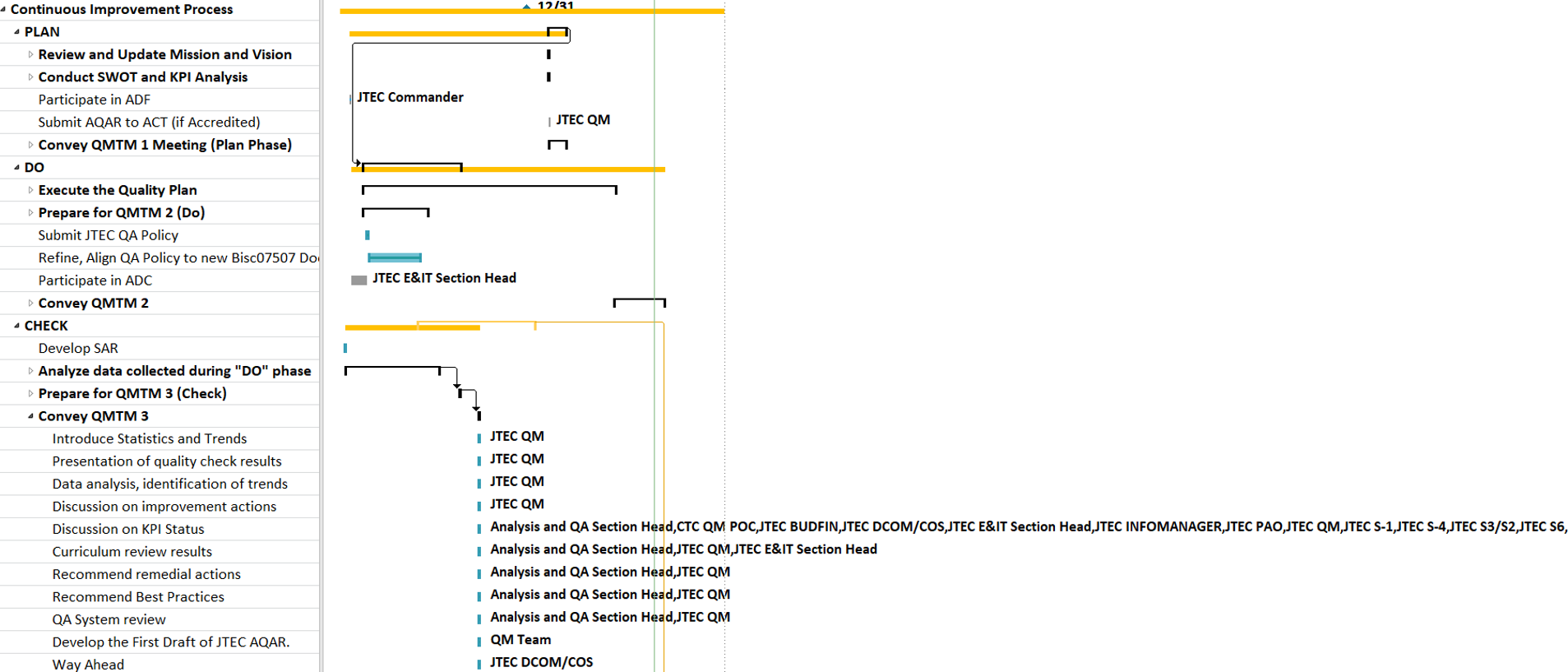
To bridge the gap between high-level responsibility and daily execution, the NATO-Georgia Joint Training and Evaluation Center (JTEC) engineered a Dynamic Task-Management Database using Microsoft Project. This best practice transforms passive RACI documentation into a live, operational radar screen. It records roles and accountabilities across 20 to 60 core Quality Management System (QMS) processes, decomposes them into specific sub-responsibilities and duties, tracks real-time execution, and empowers a small Quality Assurance team to synchronize the entire institution throughout its annual cycle.
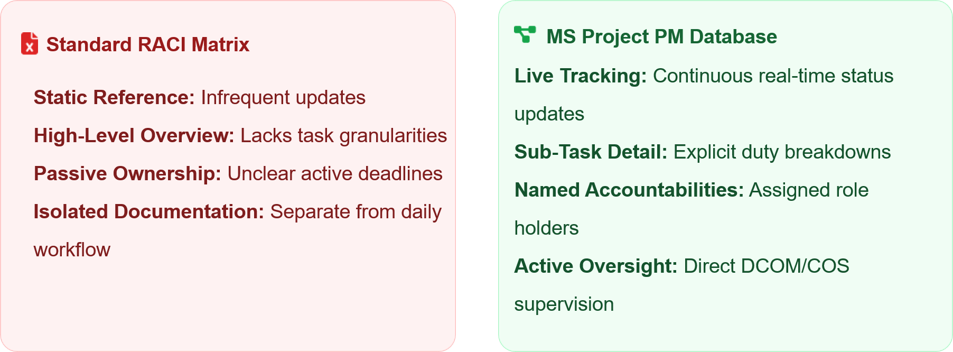
2. Core Operational Differentiators & Principles
Moving beyond static RACI charts to a project-managed QMS database provides several key operational advantages:
a. Total Task Decomposition & Named Accountability
From Ambiguity to Specificity: QMS goals (“Conduct Annual Management Review” or “Prepare Accreditation Report”) are decomposed into clear, sequential sub-tasks with assigned work hours, durations, and dependencies.
Single Named Ownership: Instead of assigning tasks to generic directorates ("S-3 Section", "S-6 Section" or "QA Branch"), every deliverable is linked directly to a specific named assignment owner (JTEC QM, Analysis & QA Section Head, S-6 Head, Education and Individual Training Section Head). This eliminates the "passive diffusion of responsibility" and ensures clear accountability.
b. Live Workload & Overallocation Analysis
Resource Optimization: By inputting resource availability and work hours into the database, leadership gains real-time visibility into staff capacity.
Identifying Overallocations: The system automatically flags when specific staff members or section heads are overallocated across multiple overlapping QMS tasks.
Driving Operational Adjustments: When severe overallocations or bottlenecks are identified, the tool provides the objective data required for leadership to sit down, discuss daily workload distribution, reassign responsibilities, or adjust operational timelines before deadlines slip.
c. Institutional Memory & Personnel Turnover Safeguards
Mitigating Staff Rotation Risks: Military and defense institutions experience frequent staff turnover and rotations. Codifying QMS workflows into structured, time-phased database templates ensures that institutional knowledge is preserved in the system rather than relying on individual memory.
Rapid Onboarding: Incoming staff members can immediately view their exact assigned responsibilities, upcoming deadlines, and required deliverables upon arrival.
3. Alignment with Modern Quality Management Principles
Developing a dynamic QMS tracking database directly incorporates core project management principles:
Quality & Project Principle | Practical Implementation in the Dynamic QMS Tool |
Continued Business Justification | Ensures every QMS activity directly supports accredited status, institutional mission, and strategic command priorities. |
Learn from Experience | Incorporates post-exercise lessons learned and previous audit findings directly as task inputs for subsequent cycles. |
Defined Roles & Responsibilities | Replaces static RACI definitions with named, active assignment owners for every sub-task. |
Manage by Stages | Aligns QMS execution with standard Plan-Do-Check-Act (PDCA) phases and executive review battle rhythms. |
Manage by Exception | Highlights delinquent tasks, milestone slippages, and overallocated staff to senior command for immediate targeted intervention. |
Focus on Products | Centers tracking around concrete, tangible deliverables (Annual Quality Assurance Reports, Course Control Documents, SOPs). |
Tailor to Suit Environment | Scales smoothly from routine daily tasks to intensive, high-tempo accreditation visit preparation. |
4. Integrating the PDCA Battle Rhythm into MS Project
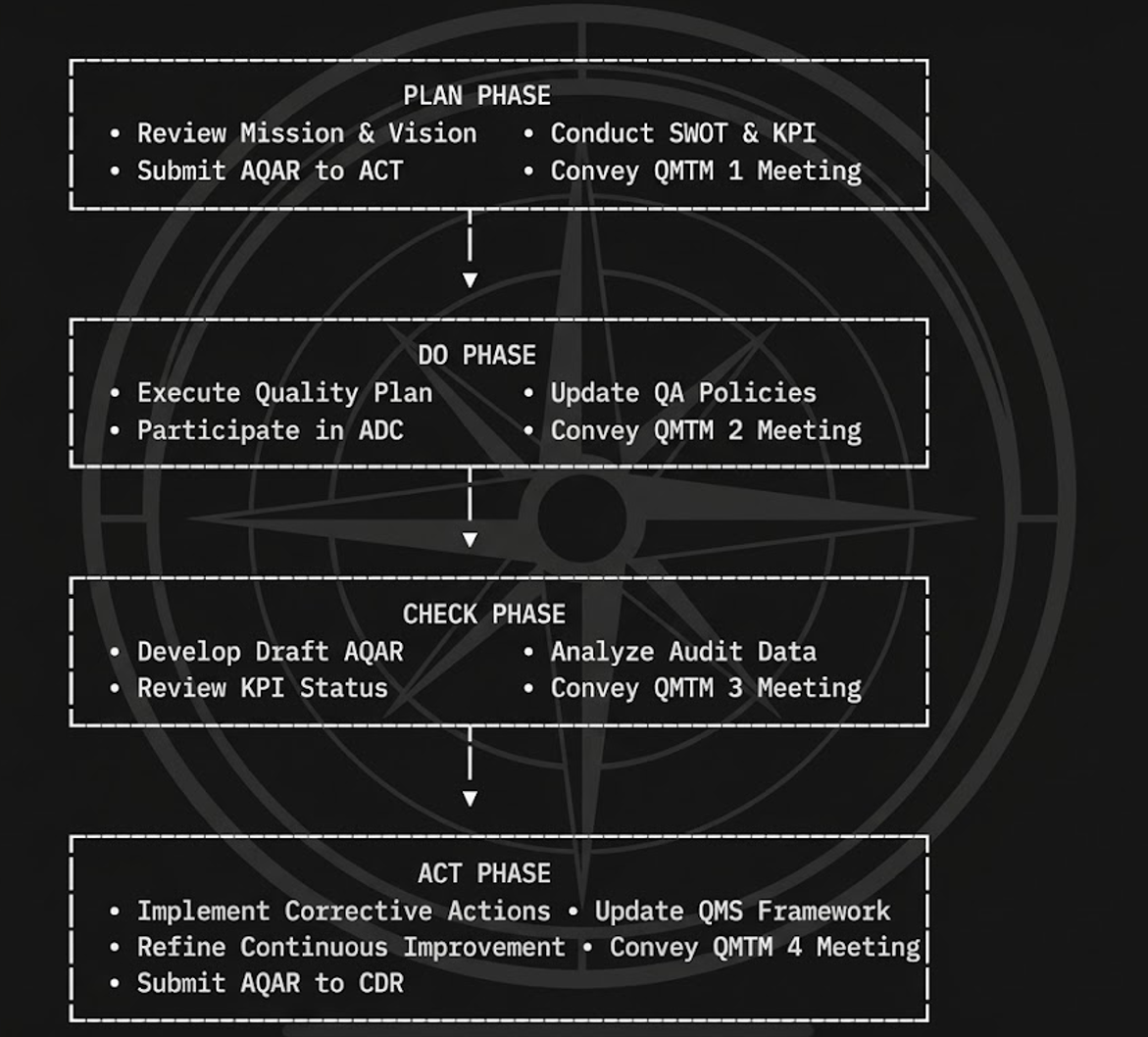
The database structures institutional quality management around the Plan-Do-Check-Act (PDCA) cycle, embedding regular Quality Management Tracking Meetings (QMTM) into the command battle rhythm:
PLAN: Review mission/vision, update key performance indicators (KPIs), conduct SWOT analyses, and establish the annual Quality Plan.
DO: Execute quality tasks, update departmental SOPs, align policies with NATO directives (Bi-SCD 075-007), and deliver staff training.
CHECK: Develop Draft AQAR, analyze internal feedback data, track KPI completion percentages, and conduct curriculum reviews.
ACT: Implement corrective actions, refine QMS processes, document best practices, and feed findings into the next planning cycle.
5. Implementation Guide for the Community of Interests (CoI)
NATO ETFs, PTECs, NATO COEs or ETFs seeking to modernize their QMS oversight can follow this step-by-step roadmap:
Convert Static RACI Lists into Task Schedules: Take existing RACI matrices and transfer them into project management software (MS Project or equivalent).
Decompose Processes into Sub-Tasks: Break high-level processes into actionable steps with defined durations, logical predecessors, and clear product deliverables.
Assign Named Resource Owners: Replace generic departmental tags with specific named position titles or roles to establish clear ownership.
Monitor Resource Allocation: Review work-hour distribution charts regularly to detect staff overallocation early and adjust task assignments collaboratively.
Embed into Command Battle Rhythm: Position the project database as a command-and-control (C2) tool during executive staff briefings rather than keeping is isolated within the QA Branch