
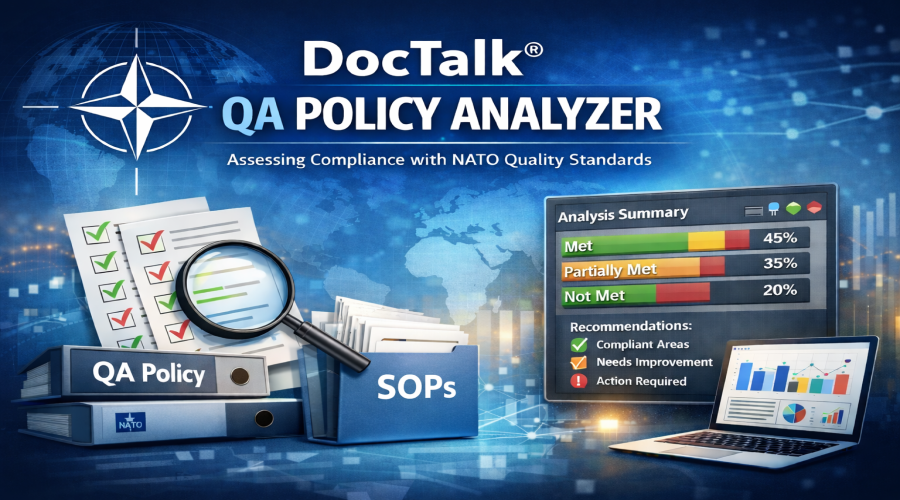
Rapid, Criteria-Based Assessment Against NATO Quality Standards
Assessing an Education and Training Facility (ETF) Quality Assurance (QA) Policy against NATO Quality Standards is a core responsibility for QA Managers, particularly in preparation for accreditation, self-assessment, and continuous improvement activities.
To support this process, the QA Hub now provides a new DocTalk® capability that enables the automated analysis of an organization’s QA Policy against a defined set of criteria, using a structured, criterion-by-criterion approach.
This capability is designed as a decision-support tool, helping institutions understand their level of compliance and identify concrete improvement actions, while fully preserving human oversight and professional judgment.
What the QA Policy Analyzer Delivers
When a QA Policy document is uploaded, DocTalk® performs a structured assessment aligned with:
NATO Quality Standards for Education and Individual Training
Bi-SC Directive 075-007 (including Annex D and Appendixes)
MC 0458/4 principles (Systems Approach to Training, Global Programming, QA governance)
Each requirement is assessed individually and marked as:
Met
Partially Met
Not Met
For every criterion, the output includes:
A concise compliance finding.
Supporting evidence identified in the policy text.
Clear, policy-aligned recommendations where gaps are identified.
An example of a full QA Policy analysis output is attached to this article for reference.
How It Works
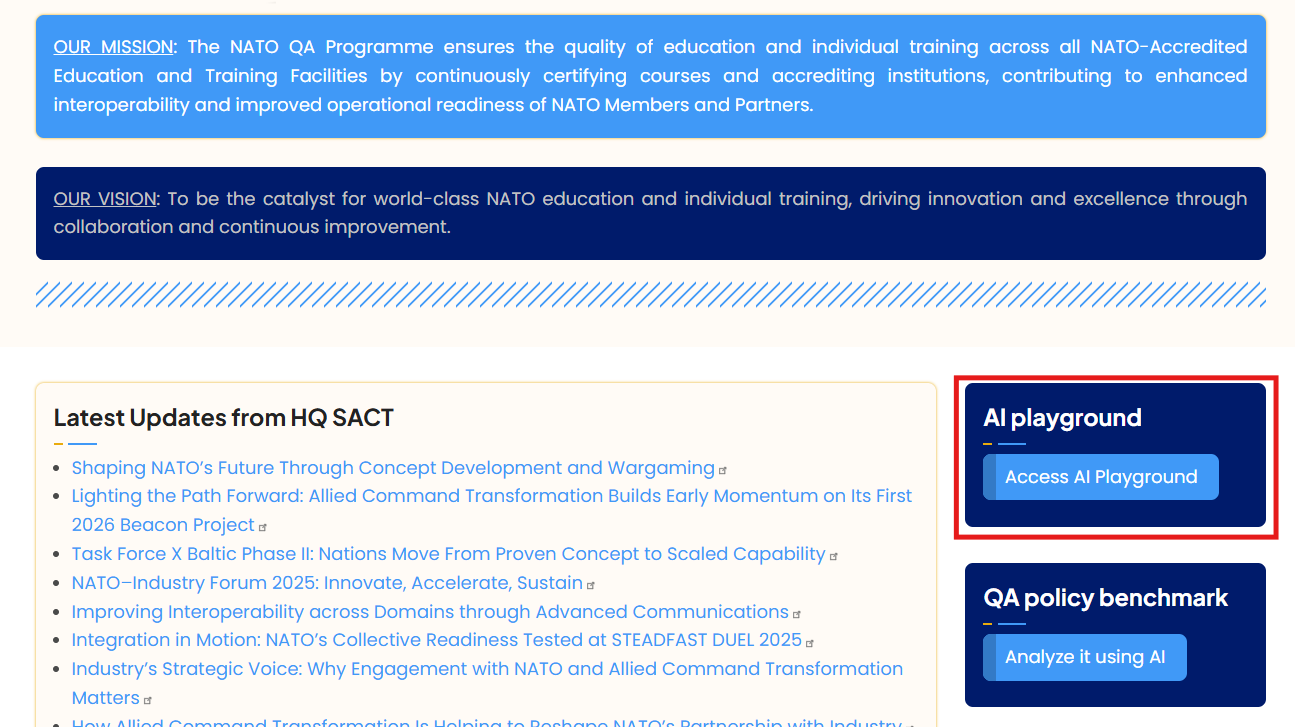
Step 1 - Access AI Playground
Click the button located into the right sidebar of the platform.
Step 2 – Upload the QA Policy
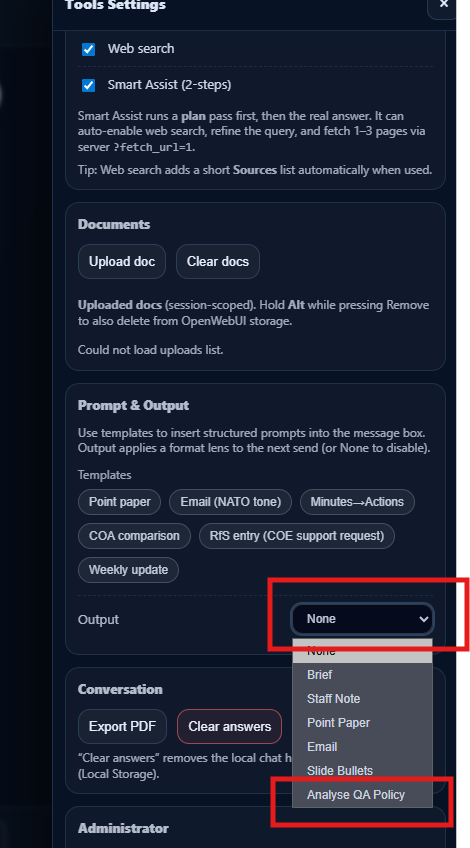
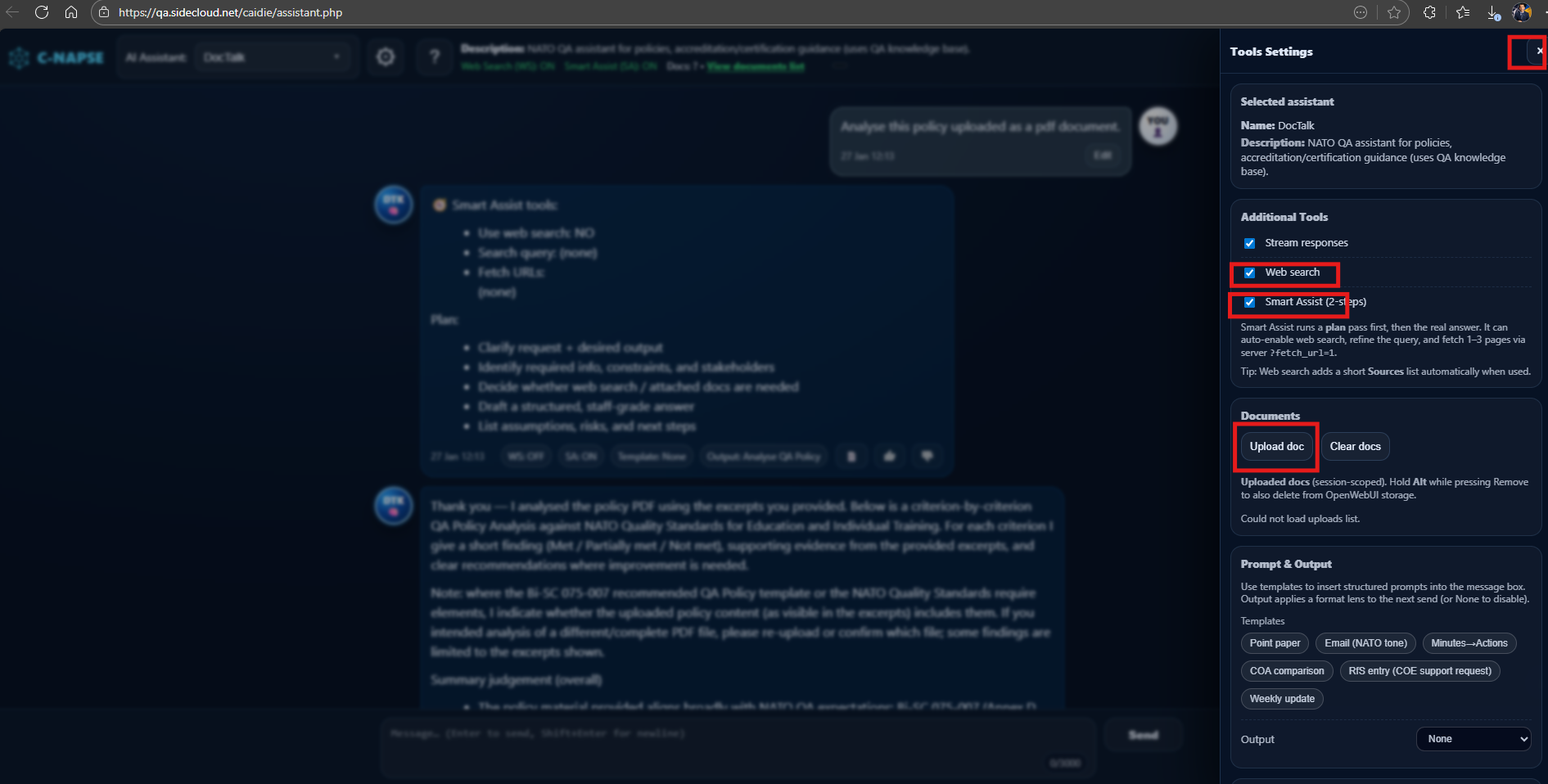
Click the gearbox icon, upload the organization’s QA Policy document via the QA Hub interface. Please make sure you select Analyse QA Policy output option from the Output drop-down menu. Also, make sure you have the Smart Assist and Web Search tools checkboxes ticked. Finally close the settings box/menu.
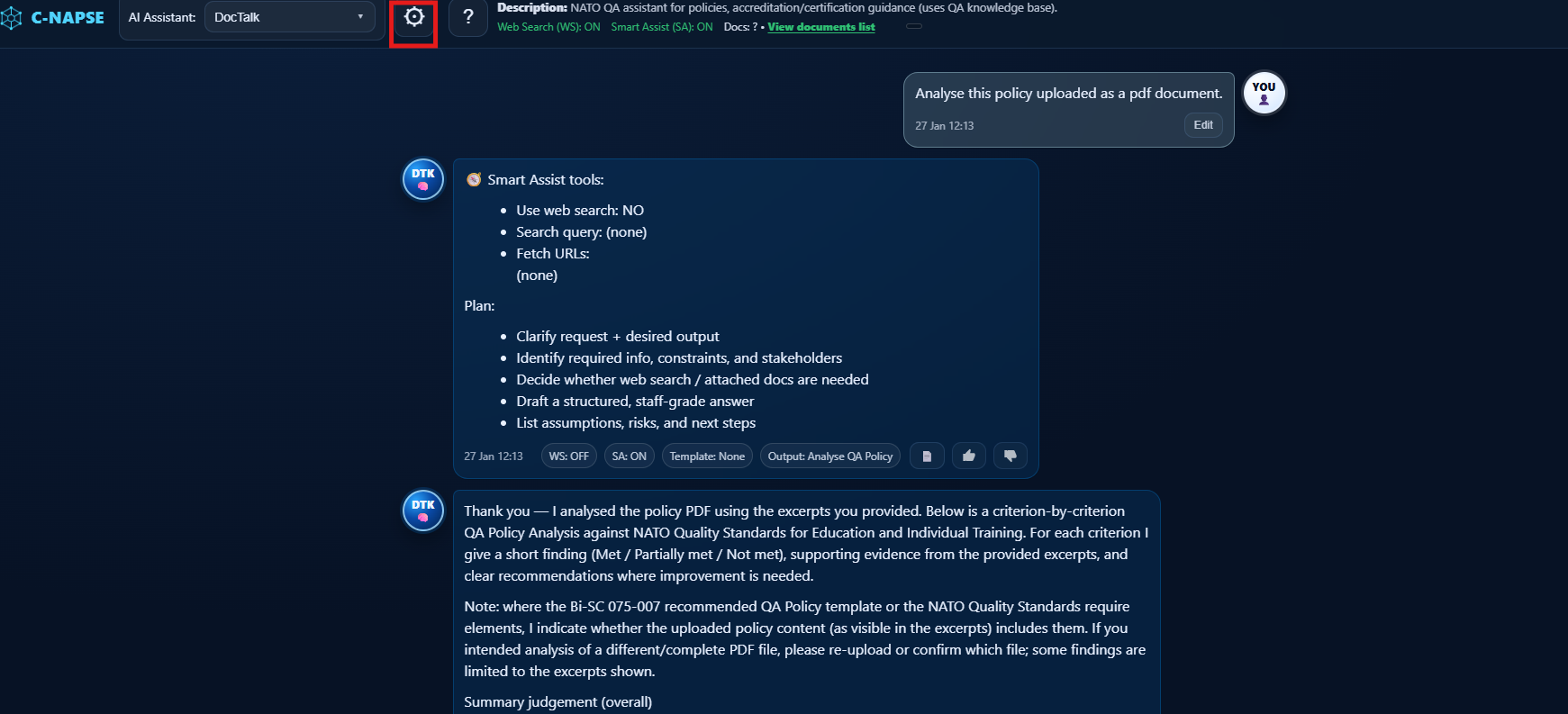
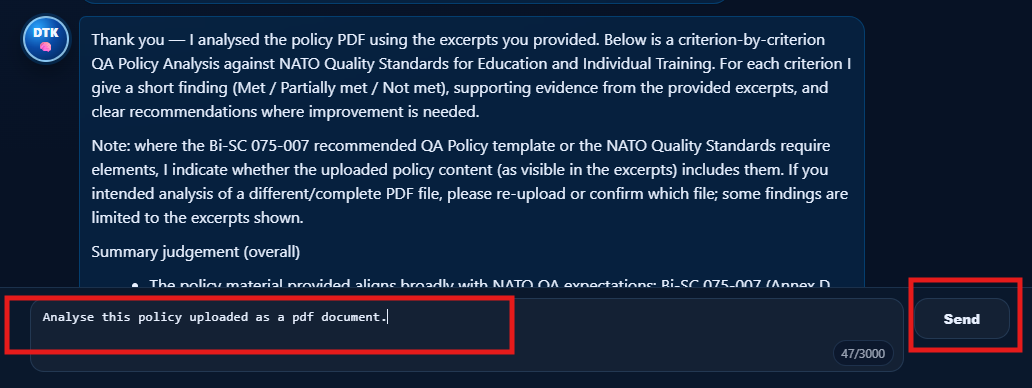
Enter the following prompt "Analyse this policy uploaded as a pdf document." in the text box, the press Send.
Step 3 – Automated Criteria-Based Analysis
DocTalk® analyzes the document against a comprehensive set of defined QA Policy assessment criteria, covering areas such as:
Governance, roles, and responsibilities
QA cycles and continuous improvement
KPIs, surveys, and feedback mechanisms
Instructor and course monitoring
Student assessment, graduation, and appeals
SOPs, documentation control, and review cycles
Resilience and continuity of training
Alignment with SAT and Global Programming
Step 4 – Structured Findings and Recommendations
The output presents a clear, criterion-by-criterion view of compliance, highlighting:
Fully compliant elements
Areas requiring clarification or additional detail
Missing or underdeveloped requirements
This allows QA Managers to immediately identify priorities for corrective action or further development.
Step 5 - Export the output as a PDF document for future reference.
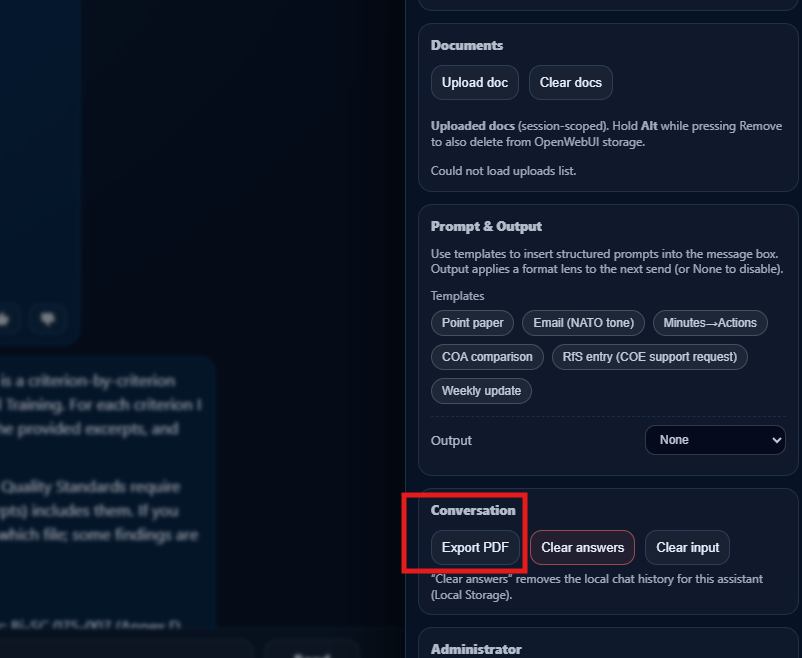
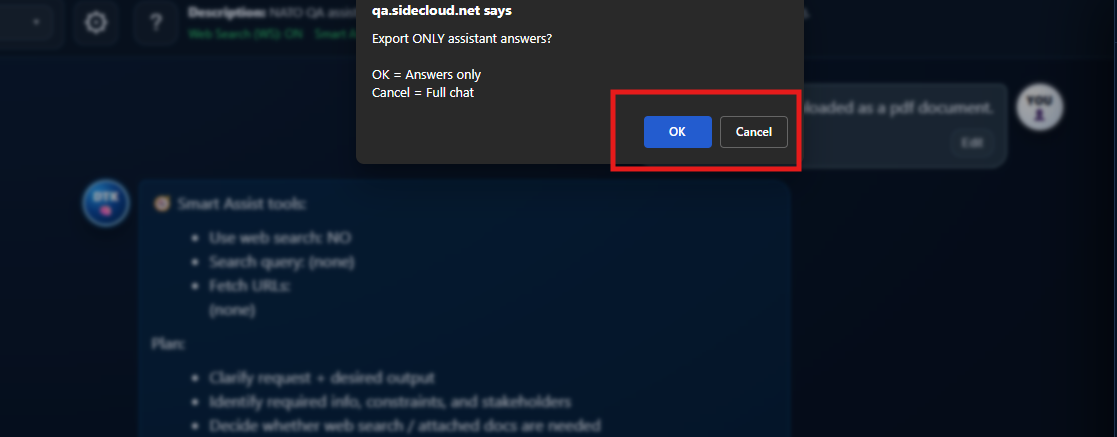
Click the gearbox icon again and scroll to the Conversation section. Press Export PDF and select OK or Cancel. Finally save the PDF document.
!!! PLEASE DONT FORGET TO PROVIDE FEEDBACK BY CLICKING THE THUMBS UP/DOWN BUTTONS. !!!
Why This Matters for QA Managers
This capability directly supports:
Internal self-assessment prior to accreditation visits or Self-Assessment Reports (SARs).
Evidence-based improvement planning, translating QA Policy assessment criteria into actionable tasks.
Consistency and transparency in interpreting QA requirements across institutions.
Rather than replacing existing QA processes, the tool strengthens them by providing a clear, structured baseline for professional analysis and discussion.
Scope and Limitations
This capability:
Does not conduct accreditation.
Does not replace QA Managers, QA Teams of Experts, or formal NATO QA processes.
Does not issue compliance or accreditation decisions.
It is intended to support preparation, reflection, and continuous improvement, with final judgments remaining firmly in human hands.
Supporting a Mature QA Culture
By enabling faster, more structured insight into QA Policy compliance, this DocTalk® feature supports a more proactive and evidence-driven QA culture across NATO Education and Training Facilities, fully aligned with the intent of NATO Quality Assurance Programme and continuous improvement process.
Comments
Innovative Tool
AI advantage
In reply to Innovative Tool by Konstantinos_K…
Great tool