
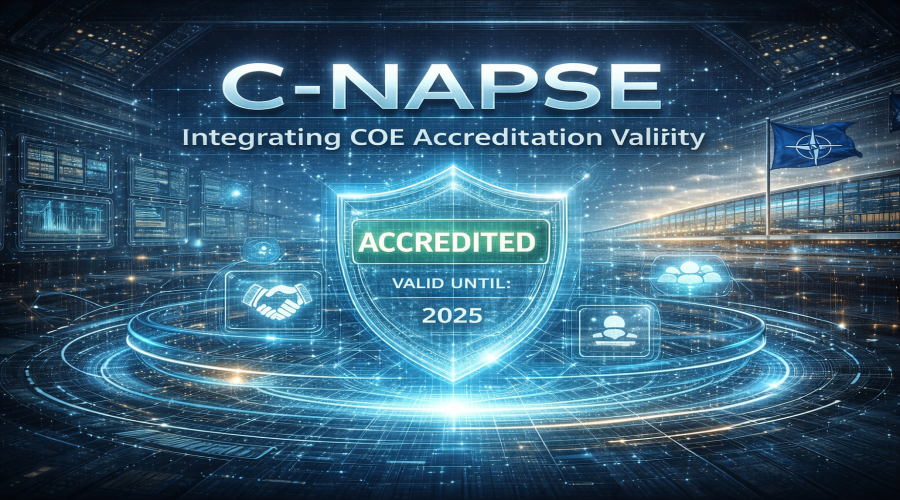
Over the past months, many of you have been introduced to C-NAPSE, the COE-Network Application for Planning, Synchronization, and Exchange. It is being developed as the new platform for coordinating work across the COE Network, gradually replacing fragmented tools and bringing everything into a single, shared environment.
Most discussions around C-NAPSE focus on workflows, Requests for Support, COE profiles, discussions, collaboration spaces. And rightly so. These are the things users interact with every day. But behind these visible features, there is a quieter shift taking place, one that is just as important: moving toward a more data-centric way of working.
A recent addition to the platform illustrates this shift in a very practical way.
Each COE participating in the NATO Quality Assurance Programme has an institutional accreditation, with a defined validity period. Until now, this information has existed, but not always where it was needed. It typically lived in reports, documents, or internal records, reliable, but not always immediately accessible.
With the latest update in C-NAPSE, this information is now displayed directly within each COE profile. When you access a profile, the accreditation validity period is simply there. No separate lookup, no cross-checking, no manual entry.
Behind the scenes, the platform retrieves this information through a secure API connection to the authoritative QA data source. For the user, however, the experience is straightforward. The data is centrally maintained, automatically updated, and presented in context. It is also read-only, which ensures that what you see is always consistent with the official record.
At first glance, this might seem like a small change. In reality, it alters how information is used.
When accreditation validity is visible directly in the platform, it becomes part of the workflow. You no longer need to verify it elsewhere. It is there when you plan activities, when you assess participation, when you coordinate with other COEs. Small steps are removed, and with them, small inefficiencies that accumulate over time.
More importantly, this is not just about accreditation data. It is a simple demonstration of how systems can be connected instead of duplicated. Instead of maintaining multiple versions of the same information, we begin to rely on a single source of truth, accessed where and when it is needed.
This is the direction C-NAPSE is moving toward. Not just a place where information is entered and stored, but an environment where relevant data is brought into context and made immediately usable.
The integration of accreditation validity is only a first step, but it points to what comes next. The same approach can be applied to other QA elements, to performance indicators, to reporting inputs, and to connections with other NATO systems. Each integration reduces fragmentation and strengthens the overall coherence of how the COE Network operates.
C-NAPSE is often described as a coordination platform, and that is accurate. But increasingly, it is becoming something more. It is evolving into a space where coordination is supported by live, reliable data, not documents, not copies, but connected information.
This particular feature may be small on the surface. But it captures a much larger idea.
And that idea is already in motion.
To access C-NAPSE platform click HERE.